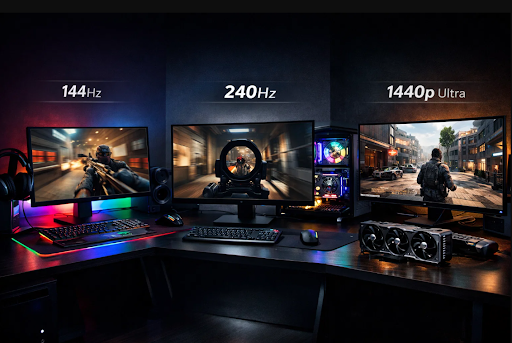
High-refresh gaming is not reserved for esports professionals only. At the moment, the 144Hz monitors are common, and 240Hz panels are widely available. The players now expect fluid motion even at higher resolutions. And because of that shift, the graphics cards are now the main part of every serious gaming build.
The challenge occurs when you understand that not all GPUs perform equally across refresh rates and resolutions. A card thatfeels smooth at 144Hz can fluctuate perform at 240Hz. While another may dominate esports titles, but struggles once the resolution increases.
That is why we bring you this guide that break downs the best graphics cards for each competitive scenario. And you will also learn about why certain GPUs excel at 144Hz, which ones can handle 240Hz, and which cards are a good option for ultra-resolution competitive play.
How Refresh Rate and Resolution Shape GPU Choice
Higher refresh rates increase performance pressure. The GPU must produce frames quickly and consistently, not just in short bursts.
At 144Hz, stability matters most. Your GPU needs enough headroom to stay above the refresh limit during intense scenes.
At 240Hz, frame pacing becomes unforgiving. Even small dips are noticeable.
The ultra-resolution gaming increases the load more and demands memory bandwidth with stronger shaders and better thermal control.
That is the reason you should prioritize the following factors before choosing a GPU,
- Stable frame delivery over peak benchmarks
- Cooling that sustains clocks under long sessions
- Strong CPU scaling in esports titles
- Enough VRAM for modern engines
With that baseline, the GPU choices below make sense.
Best Graphics Cards for 144Hz Gaming
144Hz gaming is about balance. You want smooth performance without paying for excess power you will never use.
NVIDIA RTX 4060 Ti
This GPU is the best optionfor 144Hz gaming at 1080p. It remains capable at 1440p in competitive titles. The NVIDIA RTX 4060 Ti delivers consistent frame pacing and stays efficient under load, which helps during long gaming sessions. It card suits players who want reliable performance without any thermal noise or power spike.
For esports titles, the RTX 4060 Ti comfortably exceeds the refresh ceiling. For modern games, it allows higher settings without sacrificing responsiveness.
AMD Radeon RX 7700 XT
The RTX 7700 XT offers raw raster performance with strong value. It can handle 144Hz gaming smoothly at 1080p and 1440,p both, especially in titles that require GPU throughput. The card attracts the players who want strong performance without paying a premium for features they might not use.
In addition to this, the memory configuration of the GPU helps in maintaining stability in newer games that can push texture quality harder.
Best Graphics Cards for 240Hz Competitive Gaming
240Hz gaming exposes weaknesses instantly. GPUs in this category must deliver extremely high and consistent frame rates.
NVIDIA RTX 4070 Super
This GPU is one of the standout choices for serious competitive players. It sustains very high frame rates and easily maintains excellent frame time consistency. You can pair it up with a fast CPU, and it will handle esports titles effortlessly. You can enjoy the benefits from NIVDIA’s latency-reduction features.
This card is frequently considered the best GPU for competitive FPS games because it prioritizes responsiveness and stability over visual excess.
AMD Radeon RX 7800 XT
The RX 7800 XT competes in the 240Hz space. It can deliver high frame ceilings in CPU-bound esports titles. The GPU maintains performance during extended competitive sessions. It has strong raster output and thermal efficiency, which makes it a solid option for players who prefer AMD’s ecosystem.
For high-refresh competitive play, it offers excellent performance without unnecessary complexity.
Best GPUs for 1440p Ultra-Resolution Competitive Gaming
1440p has become the preferred resolution for players who want sharper visuals without abandoning high refresh rates.
NVIDIA RTX 4080 Super
The RTX 4080 Super dominates 1440p high-refresh gaming. It allows players to maintain smooth performance while increasing visual clarity, which helps with target visibility in competitive environments. Frame pacing remains consistent even in demanding scenes, making it ideal for players who want premium performance without compromise.
This GPU fits gamers who split time between competitive play and visually rich titles.
AMD Radeon RX 7900 XTX
The RX 7900 XTX offers massive raster power and excellent memory bandwidth. It handles 1440p ultra-resolution gaming confidently while sustaining high refresh performance. Its VRAM capacity also adds longevity as games continue to demand more memory.
For players focused on long-term value and raw performance, this card remains a strong contender.
Competitive Gaming at 4K: Reality Check
4K competitive gaming exists, but it demands realistic expectations.
Even the most powerful GPUs require careful settings management at this resolution. Visual effects often need reduction to maintain stability, and upscaling becomes part of the workflow rather than an optional enhancement.
In practical terms:
- Frame stability matters more than ultra settings
- Power draw and cooling become critical
- Only top-tier GPUs handle this consistently
For most competitive players, 1440p remains the smarter choice.
NVIDIA vs AMD in Competitive Scenarios
NVIDIA GPUs lead the esports environment because of the driver maturity and consistent optimization across popular competitive titles. There are many tournament setups that rely on NVIDIA hardware for performance.
On the other hand, AMD GPUs counter with excellent raster performance and competitive pricing. At 1440p, these cards offer you outstanding results and continue to improve with driver updates.
In short, both companies produce top gaming GPUs. Which one is better for you depends on your resolution, games, and budget priorities
Performance Differences Across Game Types
Esports titles emphasize speed and consistency. They benefit most from high FPS GPUs that scale well with fast CPUs and maintain stable frame delivery.
Modern AAA games stress GPUs differently. They demand higher memory capacity, stronger shading performance, and better bandwidth. GPUs that succeed here balance visuals and performance carefully.
Understanding your primary game type helps narrow GPU options quickly.
Buying GPUs for Teams and Enterprise Use
When purchasing hardware for esports teams, training labs, or gaming cafés, priorities change.
Consistency, thermals, and support matter more than peak benchmarks. Many organizations choose to buy graphics cards in bulk to standardize systems, simplify maintenance, and ensure predictable performance across multiple machines.
In these cases, proven models often outperform newer releases over time.
Common GPU Buying Mistakes
Gamers still make avoidable mistakes when choosing GPUs:
- Paying extra for cosmetic features
- Ignoring cooling quality and throttling risks
- Overspending on performance that they cannot reach
Smart buyers focus on sustained performance and system balance instead.
Conclusion
Choosing the right graphics card depends on how you game, not on hype or benchmark charts. 144Hz gaming rewards balance and efficiency. 240Hz competitive play demands raw speed and consistency.
Ultra-resolution gaming requires careful trade-offs between clarity and performance. When your GPU matches your refresh rate, resolution, and playstyle, performance feels effortless.
Focus on stability, cooling, and long-term value. Do that, and your graphics card will support your skill rather than limit it.