
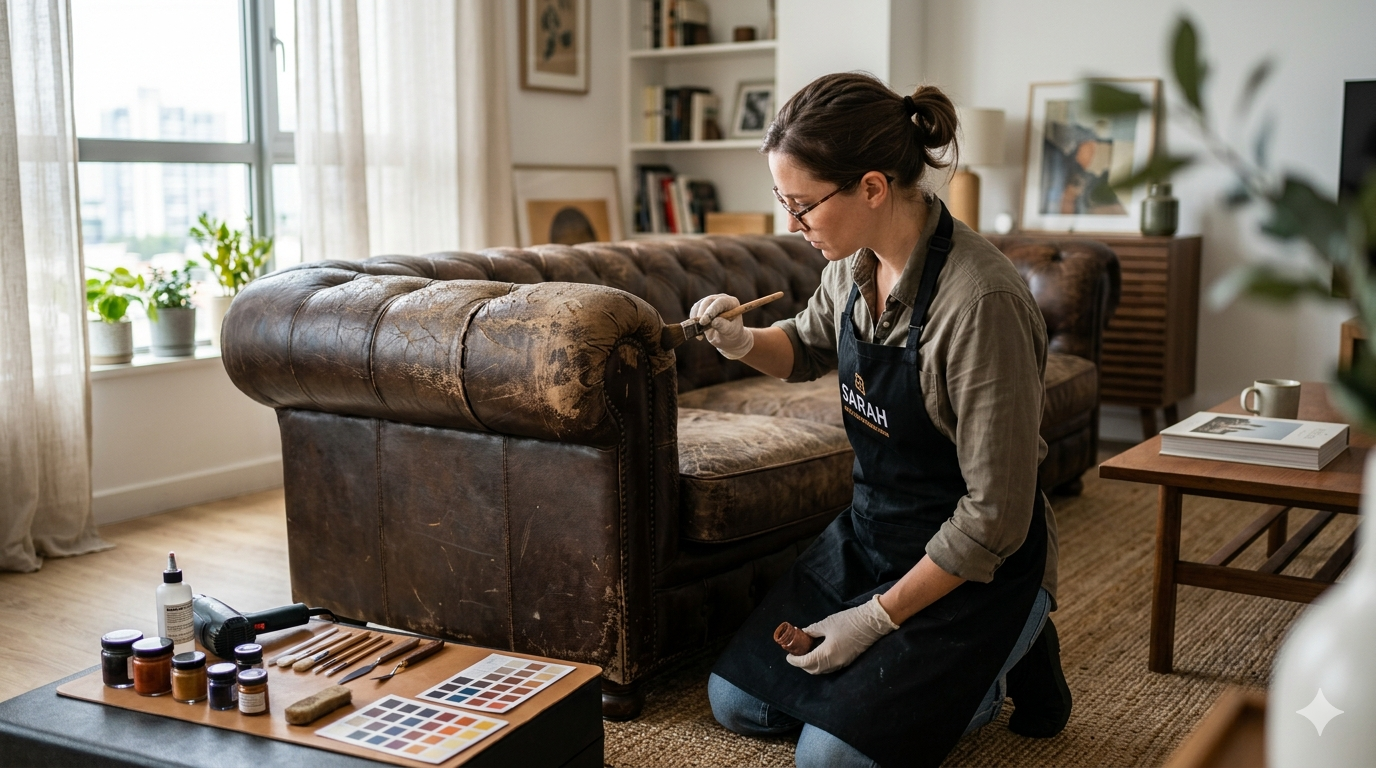
Most people see leather repair as a technical service.
A scratched sofa gets repaired. A faded armrest gets recolored. A cracked cushion gets restored. From the outside, it may appear to be a straightforward process focused only on fixing visible damage.
But for professionals who work with leather every day, restoration is much closer to an art form than most people realize.
True leather repair requires more than materials and tools. It demands patience, precision, observation, and an understanding of how leather behaves over time. Every piece is different. Every repair presents unique challenges. And no two restorations are ever exactly the same.
This is what separates basic repair from craftsmanship.
Understanding the Character of Leather
Leather is a natural material, which means it changes constantly throughout its lifespan.
It reacts to sunlight, friction, temperature, moisture, and everyday use. It softens in some areas and becomes firmer in others. It develops texture and variation that synthetic materials simply do not have.
Because of this, repairing leather is not like repainting a wall or replacing a mechanical part.
The goal is not just to “cover damage.”
The goal is to preserve the natural appearance, texture, flexibility, and character of the material while restoring the damaged areas as seamlessly as possible.
That requires an artistic eye.
The Challenge of Color Matching
One of the most difficult aspects of leather restoration is color matching.
Leather rarely fades evenly. Armrests may become lighter from constant contact. Seat cushions may darken or fade differently depending on sunlight exposure and use patterns.
A technician cannot simply apply one generic color and expect natural results.
Instead, restoration specialists carefully blend pigments to recreate the tone, depth, and subtle variations already present in the leather.
This process resembles the work of a painter more than a standard repair technician.
Small adjustments in pigment can dramatically affect the final appearance. Matching aged leather requires both technical knowledge and visual sensitivity.
The objective is not perfection in isolation — it is harmony with the surrounding material.
Restoring Texture and Balance
Leather repair also involves preserving texture.
Poor-quality repairs often leave surfaces looking flat, overly smooth, or artificial. Skilled restoration specialists understand how to rebuild damaged areas without destroying the natural grain and feel of the leather.
This requires controlled application of fillers, careful sanding techniques, and layered finishing methods.
The repair must remain flexible, natural-looking, and visually balanced with the rest of the furniture.
Achieving that balance is part technique and part artistry.
Why Experience Matters
Two technicians can use the same materials and achieve completely different results.
The difference often comes down to experience and attention to detail.
Experienced leather specialists learn to recognize subtle differences in leather type, finish, aging patterns, and wear characteristics. They understand how various materials react during the restoration process and how to adjust techniques for different situations.
This level of understanding develops over years of hands-on work.
Like many crafts, leather restoration relies heavily on trained observation.
Every Piece Tells a Different Story
One reason leather repair feels artistic is that every project carries its own history.
A family sofa may show years of everyday use in the exact places where people sit most often. A luxury recliner may have developed fine surface cracks from sunlight exposure near a window. A vintage leather chair may require delicate restoration to preserve its original appearance.
Each piece presents a different combination of wear, aging, and material behavior. Understanding what Worn Color on Leather Furniture Really Means is an important part of the restoration process, because fading and discoloration often reveal how the leather has aged, how it was used, and which areas experienced the most friction, sunlight, or moisture exposure.
There is no universal formula.
The technician must adapt the repair process to the individual piece while maintaining consistency and natural appearance.
The Human Side of Restoration
Furniture is often deeply connected to personal life.
People build routines around it. Families gather around the same sectional for years. Certain chairs become familiar spaces associated with comfort and routine.
Because of this, restoring furniture is not only about materials.
It is also about preserving familiarity and extending the life of something meaningful.
Many homeowners feel attached to furniture that has been part of their home for a long time. Replacing it may feel unnecessary when the structure and comfort are still there.
Restoration allows the furniture to continue its story rather than ending it prematurely.
Modern Technology Meets Craftsmanship
Today’s leather restoration industry combines traditional craftsmanship with modern repair technology.
Advanced flexible fillers, professional spray systems, durable protective coatings, and precision color-matching systems have significantly improved the quality of repairs.
However, technology alone does not create excellent results.
The technician still determines how those materials are used.
This is where artistry remains essential.
Tools can assist the process, but judgment, patience, and attention to detail are what make repairs appear natural.
Mobile Restoration and Convenience
Modern restoration has also become more accessible for homeowners.
Many people now search for services like mobile leather repair near me because mobile restoration allows furniture to be repaired directly in the home.
This approach reduces transportation risks and allows technicians to work with the furniture in its natural environment and lighting conditions.
For homeowners, it also makes the restoration process more convenient and less disruptive.
More Than Repair
At its highest level, leather restoration is not simply about fixing damage.
It is about understanding materials, preserving craftsmanship, and restoring balance between wear and beauty.
A successful repair should not draw attention to itself. It should feel natural, as though the damage was never there.
That level of subtlety requires skill that goes beyond technical work alone.
It requires creativity, precision, and experience.
In that sense, leather repair is very much an art form.
And like any form of craftsmanship, its best results are often the ones people notice the least — because everything simply looks and feels right again.