The U.S. Army has long used the ASVAB to screen candidates for cognitive readiness. Researchers—and the Army itself—are noticing that high-level Siege players tend to score well on the same subtests that predict battlefield effectiveness.
There is a moment familiar to almost every serious Rainbow Six Siege player: the round is nearly over, your team is down two operators, and you have roughly four seconds to read the sound cues coming through a reinforced wall, calculate the remaining utility across three possible entry points, and make a decision. Get it right and you win the round. Get it wrong and you respawn watching the killcam in silence.
That pressure-cooker problem-solving is not just good gaming. It maps almost exactly onto the cognitive skills the Armed Services Vocational Aptitude Battery—better known as the ASVAB—has measured in military candidates since 1968. The U.S. Army designed the ASVAB to identify recruits who can process information quickly, reason spatially under pressure, and apply arithmetic logic in unfamiliar situations. Sound familiar?
Where the Overlap Actually Lives
The ASVAB consists of ten subtests, but the ones most relevant to tactical gaming are Spatial Reasoning, Arithmetic Reasoning, and Mechanical Comprehension. Each targets a specific mental process that Siege rewards at a competitive level.
Spatial reasoning is perhaps the clearest bridge. Elite Siege players maintain an internalized, three-dimensional map of every level in the game—they know not just where walls are, but which walls can be breached, which angles exist above and below them, and what audio reaching them right now means about enemy movement two floors up. The ASVAB’s Assembling Objects subtest measures the same capacity: mentally rotating and reconstructing fragmented spatial information into a coherent picture.
The best Siege players aren’t reacting to the game. They’ve already modeled three possible versions of the next five seconds before they act.
Arithmetic reasoning comes into play every time a team manages its utility. Two Sledge charges. One Thatcher EMP. Three hard breaches. Four potential entry points. Which combination of operators and gadgets gives the attack team the highest probability of a clean execution? High-level players solve that problem implicitly in the planning phase—the same logical sequencing that structured ASVAB practice test preparation is designed to sharpen.
The Army Noticed It First
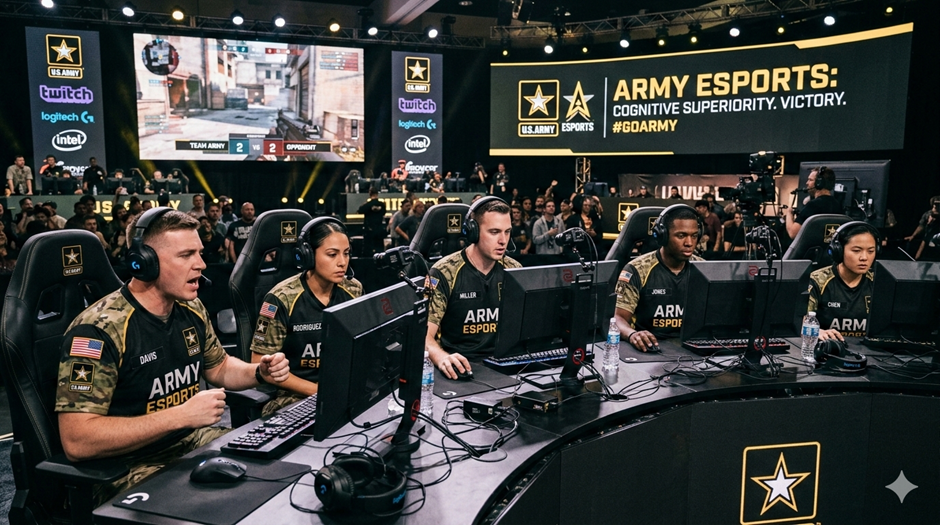
The U.S. Army Esports program, established in 2018, was originally a recruitment and community outreach initiative. But it produced an unexpected data point: recruits who scored in the upper percentiles on ASVAB spatial and reasoning sections adapted to competitive tactical shooters noticeably faster than peers with lower scores. The Army wasn’t creating gamers. It was discovering that strong ASVAB candidates were already wired to play this way.
That connection has since drawn interest from researchers studying how game-based performance translates to real-world aptitude assessment. While no large-scale peer-reviewed study has yet formally connected ASVAB scores to Siege rank, the qualitative pattern from the Army Esports program aligns with what cognitive psychologists already know about spatial reasoning and decision-making under time pressure.
What This Means for Your Game
For Siege players looking to understand their own cognitive strengths and gaps, spending time with a free ASVAB practice test is a genuinely useful diagnostic—regardless of whether military service is on anyone’s radar. The test surfaces specific weaknesses in spatial processing and numerical reasoning in a structured format that ranked matchmaking simply can’t replicate. If the Mechanical Comprehension section gives you trouble, there’s a decent chance you’re also struggling to predict breach angles and gadget interactions in the moment.
The deeper value of structured ASVAB test preparation is the habit it builds: working through problems deliberately, not impulsively. That discipline—reasoning before acting—is the single trait that separates a Diamond player who dies in a 50/50 peek from one who manufactures a 70/30 situation before pulling the trigger.
Siege is not a game won by the fastest hands. It is won by the most organized mind. And the military has been training and testing for that exact quality for over fifty years.